3D ANZ
About 3D ANZ and Tim Elliot
Rhino CAD specialist, designer, engineer, artist and founder of 3D ANZ.
I've spent a good part of my working life discovering what happens when design, software and manufacturing technology meet.
My work has taken me from industrial and product design to architecture, marine design, mechanical engineering and digital fabrication. Along the way I've also used the same tools to design sculptures that have ended up on beaches, in exhibitions and in some rather unexpected places.
For me, design has always been a process of asking "what if?" You try something, discover something, change your mind and try something else. The software should make that conversation easier, not get in the way of it.

First I had to be convinced about CAD
From two-dimensional drafting to three-dimensional design
My first serious encounter with computer-aided drafting came while studying for a Master's degree in design at Domus Academy in Milan, Italy.
Computer-aided drafting was being presented as a plausible future. I wasn't convinced.
I was sufficiently unconvinced to dismiss the technology and subsequently watched a company I was involved with go bust.
That was a useful lesson.
But there was another problem I had been trying to solve:


In 1982, while completing my BA at Ravensbourne College of Art & Design, I developed a modular shelving system as part of my final submission. It was inspired in part by the spatial puzzles of M. C. Escher and combined three entirely separate underlying structures. The shelves themselves bound those structures together, rather than simply being supported by them.
The principle of how it went together was actually very simple. Trying to represent it with pencil and paper on a two-dimensional drawing board wasn't. I spent the best part of a year trying to resolve it through manual drafting.
The quickest way to understand it was actually to make it.
So I already knew how difficult it could be to communicate a three-dimensional design through two-dimensional drawings when I arrived at Domus Academy.
What I encountered there was computer-aided drafting, and at that time the process I saw was still essentially two-dimensional. I had seen no evidence of three-dimensional CAD, other than some early animated branding on television.
Putting the drawing board onto a computer wasn't yet answering the question I was interested in.
You see, there is some irony hiding inside the initials CAD, and it's exactly why I'm averse to acronyms. Sometimes they just don't help.
CAD has been used to mean both Computer Aided Drafting and Computer Aided Design.
Those are not quite the same ambition.
Drafting is principally about communicating a design: producing drawings, dimensions, annotations and documentation.
Design is the larger activity: deciding what something should be, how it should work, how its form should develop and how its components should relate to one another.
That was the bit I was interested in.
When I began my MPhil in computer-aided design at Gray's School of Art, jointly with the Scott Sutherland School of Architecture in Aberdeen, Scotland, one of the first questions I asked was what I could actually do with the mainframe computer I'd been given.
There wasn't a CAD package sitting there waiting for me.
So I went back to the problem I'd struggled with in 1982. Could I do something better than the computer-aided drafting I'd been introduced to in Italy?
With no previous programming experience, I decided to write a Fortran program to calculate the XYZ coordinates needed to recreate the 1982 design as three-dimensional geometry and create a boundary representation.
Yes, I've been doing this since the design-osaur era.
And suddenly I could see what computer-aided design, rather than simply computer-aided drafting, might actually mean.
I've recreated the same form in Rhino today in about ten minutes.
The design hasn't become simpler. It was always simple. What has changed is how directly I can work with it.
The MPhil gave me a particularly useful perspective. I became comfortable working with computer-aided design in architecture as well as creative 2D and 3D design.
From CAD to Rhino
And eventually to 3D ANZ
My experience with early CAD technologies is one reason I'm cautious about making quick judgements about software.
By then I'd learned to understand a technology before deciding what I thought of it.
My early career included work in the UK CAD publishing industry, including as editor of CADdesk, CADD and MicroStation User magazines, and later as conference chair for SolidModelling '99.
That gave me a broad view of the rapidly developing CAD industry and the people using it.
I saw different approaches to computer-aided design emerge. I watched technologies become established. I saw some ideas work brilliantly and others become accepted simply because they had been around for long enough.
Then I discovered Rhino.
Actually, that discovery began before Rhino became the standalone tool we know today.
I explored an early sandbox prototype called AccuModel for AutoCAD. It had too many limitations in that environment, but nonetheless morphed into the standalone tool we know today.
So when I say I've worked with Rhino for more than 26 years, that's actually the conservative version.
Why Rhino?
Discovery is part of the appeal
You can start with an idea, change your mind, try something else and keep working.
Good design often involves changing your mind.
For me, that's the conversation. What if I try this? What happens if I change that? Sometimes the result is what I expected. Sometimes it suggests something else.
As a co-founder of Simply Rhino, I was keen to show people that Rhino didn't have to be complicated.
When you work with real geometry in a direct modelling way, I believe the process can become simpler.
That doesn't mean every design problem is simple.
It means the software doesn't always need to make the problem more complicated.
I had already spent the best part of a year discovering how difficult a simple three-dimensional idea could become when I had to describe it on a two-dimensional drawing board. I wasn't looking for software that recreated that experience on a screen.
I've worked with Rhino for more than 26 years, and I still genuinely prefer it for the freedom it gives me to explore a design.
Imagination is a process of discovery.
Designing things that have to work
From boats to mechanical engineering
One of the things I enjoy about design is that eventually somebody has to build the thing.
My work has included marine design, including the hull and deck design for the Haines Hunter SP725. The interior was designed by others.

Marine design is a good test of whether a model is more than just a pretty picture. The surfaces have to work, the proportions have to work, and eventually the design has to become something that can be manufactured and put into the water.
The SP725 went on to win Overall Boat of the Show and GRP Fishing Boat Open Class at the 2011 Hutchwilco New Zealand Boat Show.

When the design gets technical
Understanding how something works
A three-dimensional model isn't necessarily the end result. Sometimes it is the beginning of understanding how something works, how it could work better, and how to make the improved version.
I'm comfortable moving between design and engineering problems.
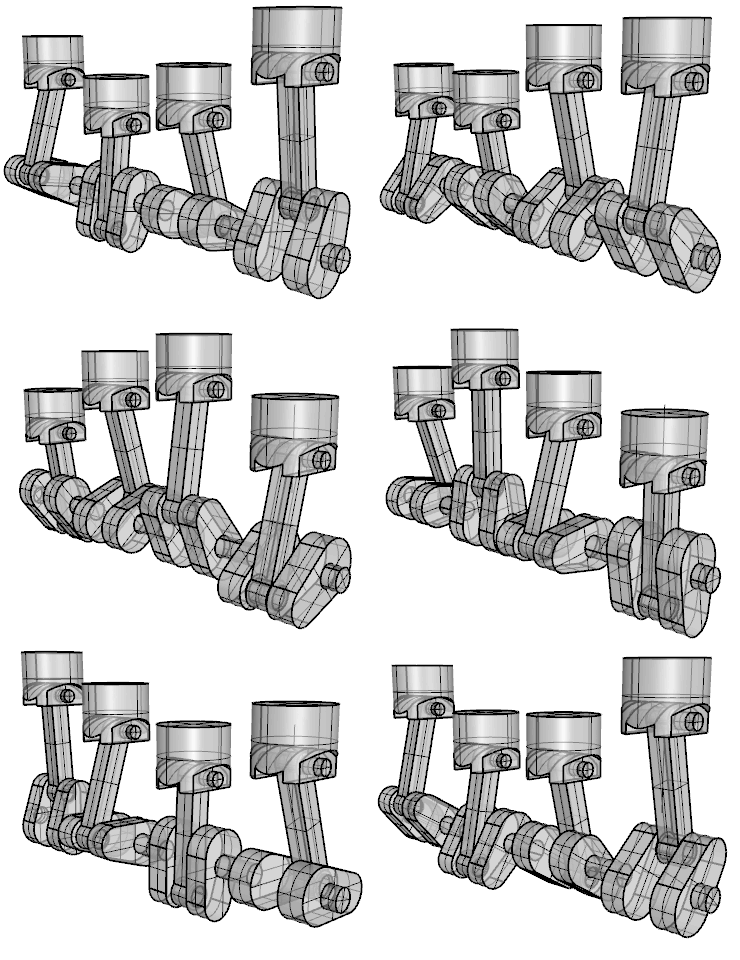
I've also worked in mechanical engineering, including a project to reverse engineer a legacy waterjet unit at a time when replacement parts were no longer available.
These were essentially aftermarket replacement parts. We worked backwards from the physical components to develop the geometry needed to manufacture them, taking the opportunity to iron out a few wrinkles that years of service had identified.

Architecture is part of the picture
Design experience across disciplines
I've always been interested in the point where an idea has to become something that can actually be built.
My experience with computer-aided design extends into architecture and jewellery design as well as industrial and product design.

Architecture is another version of that problem.
And then there is the sculpture
Because apparently CAD wasn't enough
All of my sculptures have been designed in Rhino, apart from the ones I made at school in the 1970s.
Sculpture gives me a different reason to use the same tools. There is no client specification telling me what the finished object has to look like. The challenge is often to discover what the geometry wants to do.
Perhaps that isn't so different from the shelving system I was struggling with in 1982. I tend to think in three dimensions.
Ask me to design a chair and I'll probably approach it as a sculpture you can sit in. If a table extends, I'm more likely to expose something visually curious about the extending mechanism than try to hide it. And if structure is important, as it was with that shelving system, I'll have a good go at making the structure itself intriguing.
But however unusual the form becomes, I want the person looking at it to be able to relate to it. The same premise rings true for how Rhino is presented: sophisticated capability doesn't have to be presented as intimidating complexity.

Try drawing that with a pencil on a two-dimensional drawing board.

Dawn Awakening really was a self portrait. It was first exhibited at Harbourview Sculpture Trail on the Te Atatū Peninsula. The curator didn't want me to call it Self Portrait. Atatū is a Māori word meaning "dawn", "daybreak" or "just after sunrise", hence Dawn Awakening. It doesn't mean this is what I look like at dawn, though others may disagree.
It was subsequently exhibited at Sculpture on the Shore and, when later re-titled Self-Portrait, went on to receive second place in the 2016 NZ Art in Structure competition.


Colloquially, "Number 8 Wire" is a very Kiwi expression. It has become shorthand for ingenuity, resourcefulness and making something work with whatever happens to be available.
That spirit appeals to me.
I won the President's Award in the first Number 8 Wire exhibition I entered with a sculpture entitled "Nautilus". And later in 2017, I won the People's Choice Award for "999 Eight-Gauge Seeds of Inspiration, 31 Scoops of Sunshine".
The sculpture used 999 lengths of No. 8 wire arranged in a Fibonacci spiral inspired by sunflower seeds, together with an LED light, Kiwiscoops and a cast-iron wheel. I used Grasshopper to set out the Fibonacci spiral of sunflower seeds.
Another Rhino-designed sculpture won the competition for the beach sculpture at Mairangi Bay, where it still stands today.


The work crosses the Tasman too
From New Zealand to Australia
Just as my 3D ANZ CAD business has a presence in both New Zealand and Australia, so does my art.
In 2016, the Australian Broadcasting Corporation (ABC) ran a phone-in competition to choose the People's Choice at an exhibition in which I entered a sculpture created in Rhino in collaboration with mosaicist Kate Millington.
Our kingfisher sculpture won People's Choice.

It is one of those projects that neatly demonstrates what I like about Rhino. The software doesn't particularly care whether you are designing a boat, a building, a mechanical component or a bird. This one was 2.25m long!
Design is a conversation
What if?
I don't really think of design as a straight journey towards a predetermined answer.
It is much more likely to begin with "what if?"
You try something. You look at what happened. You discover something. Perhaps you change your mind. Then you try something else.
I make extensive use of 3D ANZ's laser cutters, computer numerical control (CNC) routers and 3D printers in the manufacture of my sculptures.
The tools matter because they affect how easily that conversation can continue.
For me, that's where productivity comes into it. Productivity isn't simply doing the same drawing faster. It is about removing unnecessary work between the idea, the next "what if?", and the thing you eventually make.
What experience is actually useful for
Knowing what to do next
A long career in technology doesn't mean having all the answers.
It means having seen enough different answers to become interested in the questions.
I've learned not to dismiss something simply because I don't understand it.
I've also learned that people don't generally find CAD intimidating because they are incapable of learning it.
They find it intimidating because they don't yet feel confident about what they're doing.
That's a very different problem.
If you don't know what something means, a page full of technical terminology can make a simple idea seem complicated.
If you don't know which tool to use, every button can look like the wrong one.
And if you don't understand why something works, it is difficult to know what to try next.
That's where experience can help.
Not because I know every command.
I don't!
There are more than a thousand of them, each with its own options. So please don't suggest I have dementia if I can't remember every one of them.
The options are easy to explore. The process of discovery is simple, and that's all part of the fun.
So if I don't know the answer, I do know where to look and how to find it.
There are many ways to skin the cat in Rhino.
But you can't start by looking at it and asking whether you should skin it this way or that.
You start by picking it up.
No jargon for the sake of it
Understanding comes first
Technical subjects inevitably come with technical language. That's fine.
But technical language should make something clearer, not make you feel as though you've wandered into a conversation halfway through.
So I try to explain things.
The first time I use an acronym, I spell it out. If a term has two meanings, I say so. And if something can be explained in ordinary language, I usually prefer ordinary language.
Knowing the terminology isn't the same thing as understanding the subject.
Understanding comes first.
There is always more to discover
The interesting bit is deciding what to do with it
After all these years, I'm still discovering things.
New software, new manufacturing methods, new ways of modelling and new ways of turning an idea into something you can actually hold in your hands.
That's probably why I still enjoy it.
The software keeps changing. The machines keep changing. The possibilities keep expanding.
The interesting bit is deciding what to do with them.
Imagination is a process of discovery.Tell me what you're trying to make. We'll start there.


 Bring it in. Work with it. Take it wherever it needs to go.


 Cage
Cage Taper
Taper Twist
Twist Maelstrom
 Stretch
 Splop
Splop CageEdit
 Flow
Flow Bend
Bend